
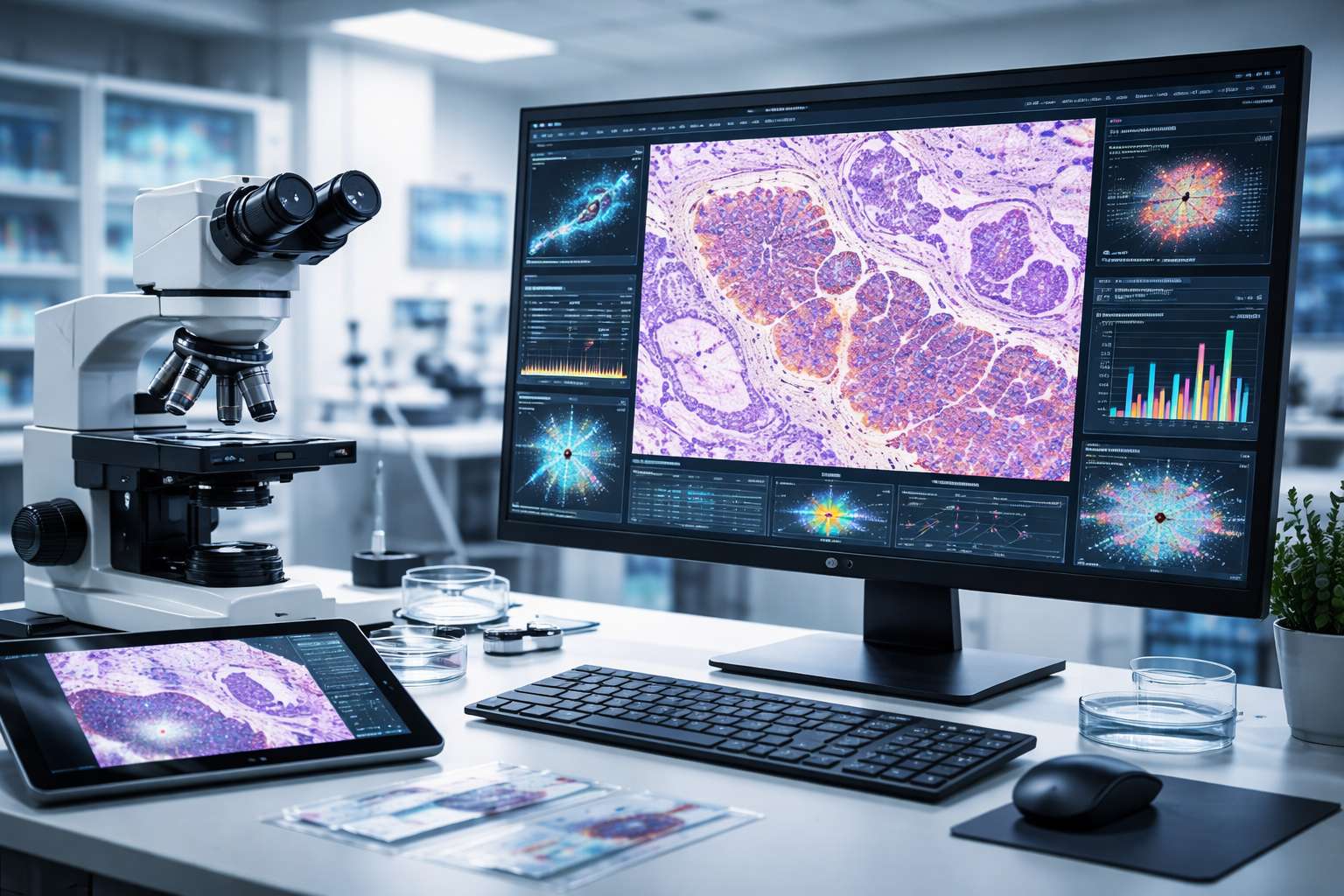
Computational Pathology | AI Diagnostics | Whole Slide Imaging | Regional Breakdown | March 2026 | Source: Wise Guy Reports
| $1.8B
Market Value by 2032 |
12.4%
CAGR (2024–2032) |
$780M
Market Value in 2024 |
Overview
Digital Pathology Market global Digital Pathology Market is projected to grow from USD 780 million in 2024 to USD 1.8 billion by 2032, registering a 12.4% CAGR. The digitisation of histopathological glass slide analysis through whole slide imaging (WSI), combined with AI-powered computational pathology algorithms capable of detecting cancer subtypes, grading tumour margins, and predicting biomarker expression with pathologist-level accuracy, is transforming anatomic pathology from an analogue, high-variability discipline into a scalable, data-driven precision diagnostic modality.
Key Takeaways
- The Digital Pathology Market is projected to reach USD 1.8 billion by 2032 at a 12.4% CAGR.
- AI-powered digital pathology algorithms detect cancer with 94.6% sensitivity — matching or exceeding senior pathologist diagnostic accuracy.
- Whole Slide Imaging (WSI) reduces pathologist reporting time by 34% while enabling remote second-opinion consultation at global scale.
- FDA has cleared 38+ AI-assisted digital pathology algorithms as of 2025, validating the regulatory pathway for computational pathology.
- Pharmaceutical and biotech companies now represent 42% of digital pathology revenue through clinical trial biomarker analysis services.
Segment & Technology Breakdown
| Technology / Segment | Primary Buyer | Key Driver | Outlook |
| Whole Slide Imaging (WSI) | Hospitals, Academic Labs | Glass slide digitisation, remote review | Core infrastructure segment |
| AI Computational Pathology | Oncology, Pathology Depts | Cancer detection, grading, biomarkers | Fastest-growing; 94.6% sensitivity |
| Telepathology / Remote Consult | Community Hospitals, LMICs | Specialist access, second opinion | Strong; workforce shortage driver |
| Pharma Biomarker Analysis | BioPharma, CROs | Clinical trial tissue analysis, IHC scoring | Largest revenue; 42% market share |
| Digital Pathology LIS/LIMS | Lab IT, Hospital Systems | Workflow integration, image management | Stable; infrastructure layer |
What Is Driving Demand?
AI Computational Pathology Accuracy Validation
Peer-reviewed clinical validations of AI computational pathology algorithms (Paige.AI, PathAI, Proscia, Aiforia) demonstrate cancer detection sensitivity of 94.6% — matching senior board-certified pathologist performance while processing slides 12-18x faster. FDA 510(k) clearances for 38+ AI pathology algorithms validate the regulatory pathway and are accelerating hospital system procurement decisions from pilot to enterprise deployment.
Global Pathologist Workforce Shortage
The WHO estimates a shortage of 140,000 pathologists globally by 2030, with sub-Saharan Africa operating at 1 pathologist per 1.5 million population versus the recommended 1 per 10,000. Telepathology and AI-assisted digital pathology platforms enabling remote consultation and automated preliminary reporting are becoming infrastructure solutions to the pathologist workforce crisis rather than optional efficiency tools.
Pharmaceutical Biomarker & Clinical Trial Demand
The pharmaceutical industry’s shift to precision oncology and biomarker-stratified clinical trials requires computational analysis of thousands of tissue samples per study for PD-L1 scoring, HER2 expression, tumour mutational burden (TMB), and spatial transcriptomics. Pharma and biotech now represent 42% of digital pathology platform revenue through clinical research lab and CRO deployments — providing counter-cyclical revenue independent of hospital system procurement cycles.
Whole Slide Imaging Regulatory Approval
FDA 510(k) clearance of whole slide imaging systems (Philips IntelliSite, Leica Aperio AT2 DX, 3DHISTECH Pannoramic) for primary diagnosis use — without a concurrent physical glass slide requirement — has removed the final regulatory barrier to all-digital pathology laboratory workflows in the United States, the world’s largest anatomic pathology market.
Spatial Transcriptomics & Multi-Omic Integration
The convergence of digital pathology with spatial transcriptomics (10x Genomics Visium, Nanostring CosMx), proteomics, and genomics is enabling multi-omic tissue analysis that correlates morphological features with molecular expression patterns — creating computational pathology platforms capable of predicting immunotherapy response, treatment resistance mechanisms, and patient survival outcomes from H&E stained slides alone.
| Get the full data — free sample available:
→ Download Free Sample PDF | Includes market sizing, segmentation methodology & regional forecast tables. |
| KEY INSIGHT: Academic medical centres deploying enterprise digital pathology platforms with AI computational analysis report 34% reduction in pathologist turnaround time for cancer diagnosis, 28% decrease in inter-observer variability on grading assessments, and USD 1.2 million average annual laboratory efficiency savings — with pharma biomarker service revenue offsetting 60-80% of platform implementation costs within 24 months of deployment. |
Regional Market Breakdown
| Region | Maturity | Key Drivers | Outlook |
| North America | Dominant | FDA clearance leadership, pharma biomarker demand, academic medical centres | Steady; AI algorithm clearance acceleration |
| Europe | Mature | IVDR compliance, NHS digital pathology rollout, Germany/Netherlands leadership | Strong; national digital lab programmes |
| Asia-Pacific | Fastest Growing | China hospital digitisation, India telepathology, Japan precision oncology | Highest CAGR; infrastructure buildout |
| Latin America | Emerging | Telepathology for rural access, Brazil cancer diagnosis infrastructure | Growing; workforce shortage driver |
| MEA | Nascent | Saudi/UAE precision medicine investment, Africa telepathology need | Early-stage; high unmet need |
Competitive Landscape
Key vendors include Philips Digital Pathology, Leica Biosystems (Danaher), Hamamatsu, 3DHISTECH, Roche (VENTANA), AI platform leaders Paige.AI, PathAI, Proscia, and Aiforia. Whole slide scanner resolution, AI algorithm CE/FDA clearance portfolio, LIS/LIMS integration, and pharma CRO service capabilities are primary competitive differentiators.
Outlook Through 2032
The Digital Pathology Market through 2032 will be defined by AI computational algorithms achieving standard-of-care clinical workflow integration, multi-omic spatial analysis platforms creating new biomarker discovery revenue streams, telepathology addressing the global pathologist workforce shortage, and pharmaceutical biomarker demand sustaining high-value CRO service revenue independent of hospital budget cycles. Vendors achieving FDA and CE clearance for primary diagnosis AI algorithms, building pharma biomarker analysis platform capabilities, and integrating with major LIS/LIMS infrastructure will define competitive leadership as anatomic pathology completes its transition from glass to digital.
Source: Wise Guy Reports | All market projections are forward-looking estimates and subject to revision.